Text Size |
Article

The role of management educators in implementing responsible management education: A systematic literature review

Nirmal Chathuranga et al.
Nirmal Chathuranga
University of Sri Jayewardenepura ROR
Kalani Madhuwanthi
University of Sri Jayewardenepura ROR
Uvini Ayathma
University of Sri Jayewardenepura ROR
Vol. 11, No. 2 (2026) E-ISSN: 2708-6178 DOI: 10.62458/jafess11cma22 CC BY 4.0 License Published: 2026-10-26
Recommended Citation (APA 7th)
Chathuranga, N., Madhuwanthi, K., & Ayathma, U. (2026). The role of management educators in implementing responsible management education: A systematic literature review. Journal of Accounting, Finance, Economics, and Social Sciences, 11(2), 13 – 24. https://doi.org/10.62458/jafess11cma22
Abstract
Purpose: This study examines the role of individual management educators in implementing Responsible Management Education (RME). It addresses a critical gap in the literature, which has disproportionately focused on institutional adoption and programme-level commitments rather than the agency, practices, and development of academics who translate these principles into reality.

Methodology: Following PRISMA guidelines, this systematic literature review identified 42 peer-reviewed articles from Google Scholar (2000–2025). The data were analyzed using the inductive Gioia methodology to capture educators' actions and mapped against the UN’s seven Principles for Responsible Management Education (PRME).

Findings: The review synthesizes individual academic action into four interconnected, mutually reinforcing themes: curriculum revisions, enhanced external engagement, embodiment of pedagogical changes, and academic development in teaching, learning, and researching (TLR). Crucially, academic development serves as the foundational connective thread, empowering educators with the research capability, credibility, and peer support required to drive the other three dimensions.

Implications: For academics, the study demonstrates that RME is enacted through everyday choices in classroom pedagogy and collaborative research. For business school leadership, it highlights that institutional change requires actively supporting educators through protected time, mentoring, and revised workload and promotion incentives that reward responsible scholarship.

Originality: By shifting the unit of analysis from the institution to the individual academic, this paper addresses why top-level PRME commitments often decouple into symbolic rhetoric. It contributes to a dynamic conceptual framework that models the individual educator as the central change agent orchestrating curriculum revision, pedagogical innovation, external collaboration, and scholarship.

Limitations and directions for future research: This review primarily draws literature from Google Scholar and provides an interpretive thematic synthesis. Future research should empirically validate the framework through surveys and interviews across diverse geographic and developing-economy contexts, while further exploring the under-researched PRME Practice principle.
Keywords: Responsible management education, PRME, Business academics, Business schools, Higher education.
Introduction
Responsible Management Education (RME) has become a prominent concern in higher education as universities respond to the Sustainable Development Goals (SDGs) (Avelar et al., 2022). Higher education is expected to prepare students, scholars, and leaders to address inequality, climate change, and other complex societal problems (Storey et al., 2017). Business schools sit at the centre of this expectation because they shape the people who run organisations. RME addresses this by integrating ethics, responsibility, and sustainability into management teaching and practice, so that future leaders look beyond profitability alone (Fujimoto et al., 2025). 

Several business schools have adopted the Principles for Responsible Management Education (PRME), a United Nations initiative established in 2007 to transform business and management education, research, and thought leadership worldwide (Henrique et al., 2024). In response to years of corporate scandals and unethical business conduct, the United Nations launched the PRME to equip future business leaders with the skills, mindsets, and values needed to balance sustainability with economic goals (Russo et al., 2023). At its core, the United Nations Principles for Responsible Management Education (UNPRME) encourages the university community to create lasting value and contribute to a more equitable global economy through innovative teaching, impactful research, and transformative academic practices (Parkes et al., 2017).

UNPRME is built on seven principles: Purpose, Values, Teach, Research, Partner, Practice, and Share, which together provide a pathway to put global sustainability goals into practice and to align RME with the SDGs and the UN Global Compact (UNPRME, 2023). Business schools that seek and obtain signatory status generally accept that responsible management means equipping graduates to recognise, support, and apply sustainable business practices (Russo et al., 2023). UNPRME now has more than 850 signatories across more than 95 countries (UNPRME, 2023). Institutions demonstrate their commitment to graduating people who can tackle global issues, attract international students, and strengthen their legitimacy and reputation (Sahni et al., 2025). Signatories are also more likely than non-signatories to use interactive and experiential learning methods, suggesting a more dynamic model of sustainability education (Henrique et al., 2025). Since UNPRME’s launch, a growing body of research has examined how business schools can embed its principles and how doing so affects their overall sustainability performance (Peschl et al., 2023). 

Table 1 presents a rich body of literature on RME. Alongside work on approaches, opportunities, challenges, progress, and prospects, a critical stream treats UNPRME as symbolic or rhetorical (Louw, 2015; Smith et al., 2023). Taken together, these studies suggest that signing the principles and changing what happens in classrooms are not the same. In this study, the seven UNPRME principles serve as a conceptual lens for examining the role of business academics in advancing RME.
AreaAuthor/s
Diverse approaches adopted by business schools in embedding SDGs for RMEAbdelgaffar, 2021; Azmat et al., 2023; Burchell et al., 2015; Cullen, 2020; Maloni et al., 2012
Opportunities and challenges associated with UNPRME implementationAbdelgaffar, 2021; Dyllick, 2015; Parkes et al., 2017; Russo et al., 2023; Solitander et al., 2012
Purpose, progress and prospects of UNPRMEAhmad & Bibi, 2023; Godemann et al., 2014; Young & Nagpal, 2013
Involvement of business schools in UNPRME‐based CSR commitmentsMoratis, 2013; Nonet et al., 2016
UNPRME as a symbolization/rhetoric in business schoolsLouw, 2015; Smith et al., 2023
Table 1: Prominent research areas on RME
This study uses the seven UNPRME principles as a conceptual lens to examine how business academics advance RME, as summarized in Table 2.
PrincipleDescriptionSource
PurposeUNPRME underscores the importance of equipping students to generate sustainable value for both business and society while fostering contributions to a more inclusive global economy.Sahni et al., 2025
ValuesUNPRME highlights the importance of integrating social responsibility and ethical values into academic curricula to prepare students to engage in ethically responsible, socially beneficial practices.Sahni et al., 2025
TeachUNPRME transforms learning environments by embedding responsible management concepts and practices into curriculum design and pedagogy.UNPRME, 2023
ResearchUNPRME engages in both conceptual and empirical research to deepen understanding of how corporations contribute to sustainable social, environmental, and economic value, as well as the dynamics and impacts of their practices.Avelar et al., 2022
PartnerUNPRME provides opportunities to collaborate with business managers to better understand the challenges they face in fulfilling their social and environmental responsibilities and to jointly develop effective approaches to address those challenges.Avelar et al., 2022
PracticeUNPRME adopts responsible and accountable management principles across governance and operational practices.UNPRME, 2023
ShareUNPRME facilitates and supports dialogue among educators, students, businesses, governments, consumers, media, civil society organisations, and other stakeholders on critical issues of global social responsibility and sustainability.Avelar et al., 2022
Table 2:  United Nations Principles for Responsible Management Education (UNPRME)
Despite this expanding literature, most studies examine RME adoption at the institutional or programme level. Existing reviews largely focus on this, and few treat business academics as the primary unit of analysis. This matters because academics translate institutional commitments into classroom practice. If their roles remain unclear, we cannot explain why top-level commitments translate into change in some schools but remain symbolic in others. This review addresses that gap by asking how business academics operationalise the seven UNPRME principles in their everyday teaching, research, and engagement, using UNPRME as a conceptual lens for advancing responsible management education. In doing so, the study makes two contributions. First, it synthesises fragmented literature into four coherent themes of academic action. Second, it develops a conceptual framework linking these themes to guide future research and practice.
Study Methods
This qualitative, literature-based study critically reviews the literature to explore how business academics should implement RME. The study analysed research on UNPRME, responsible management education, and the role of business academics. We followed the Preferred Reporting Items for Systematic Reviews and Meta-Analyses (PRISMA) (Page et al., 2021) approach to keep the selection process transparent and replicable.

We searched Google Scholar for articles published between 2000 and 2025 using the search terms ‘responsible management education’, ‘PRME’, and ‘academics’ or ‘faculty’, combined with Boolean operators [(“PRME” OR “Principles for Responsible Management Education” OR “responsible management education”) AND (academics OR faculty OR educators OR lecturers) AND (implementation OR integration OR embedding) AND “business school”]. We conducted the searches on August 25, 2025. 

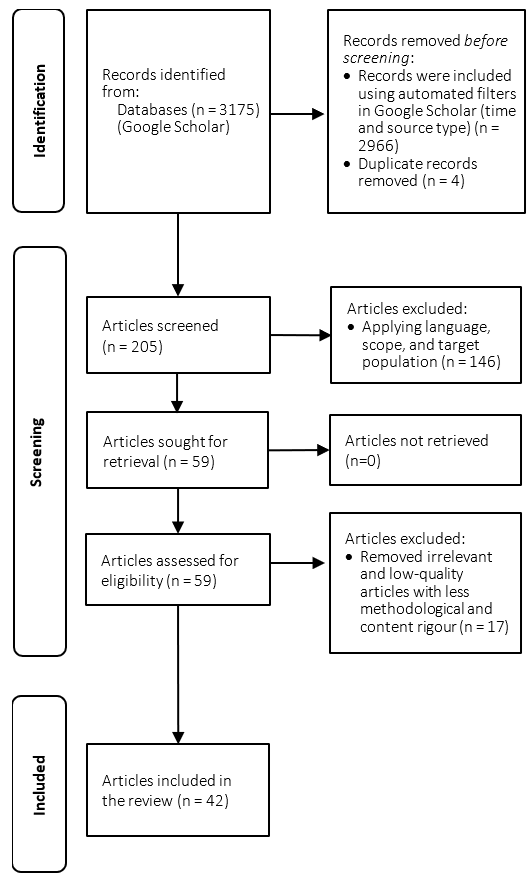
Figure 1 outlines each stage from search to inclusion of research studies. The initial keyword search returned 3175 results. After applying filters for time (2000-2025) and article type (review articles), the search returned 209 records. We removed duplicates, leaving 205 articles. We then screened titles and abstracts against the remaining inclusion and exclusion criteria (see Table 3), excluding 146 articles and retaining 59. We retrieved all 59 articles for full-text review. We then conducted a full-text review and assessed the articles’ eligibility for the final analysis. At this stage, we removed 17 articles that were irrelevant or did not meet the required inclusion criteria. We also appraised articles’ methodological clarity and their direct relevance to academics’ roles, not just to institutions. This left us with 42 articles for the final analysis.
Figure Image
Figure 1: PRISMA diagram for selecting studies for analysis
Inclusion CriteriaExclusion Criteria
Research on RME in business schools, universities, and higher education institutionsResearch conducted on RME in other entities outside the higher education sector
Role of academics in RMERole of students, administrative and non-academic members, and other stakeholders in RME
Articles from peer-reviewed journalsArticles that are not in peer-reviewed journals
Articles published in EnglishArticles published not in English
Research conducted between 2000-2025Research conducted outside 2000-2025
Table 3: Inclusion and exclusion criteria used in selecting studies

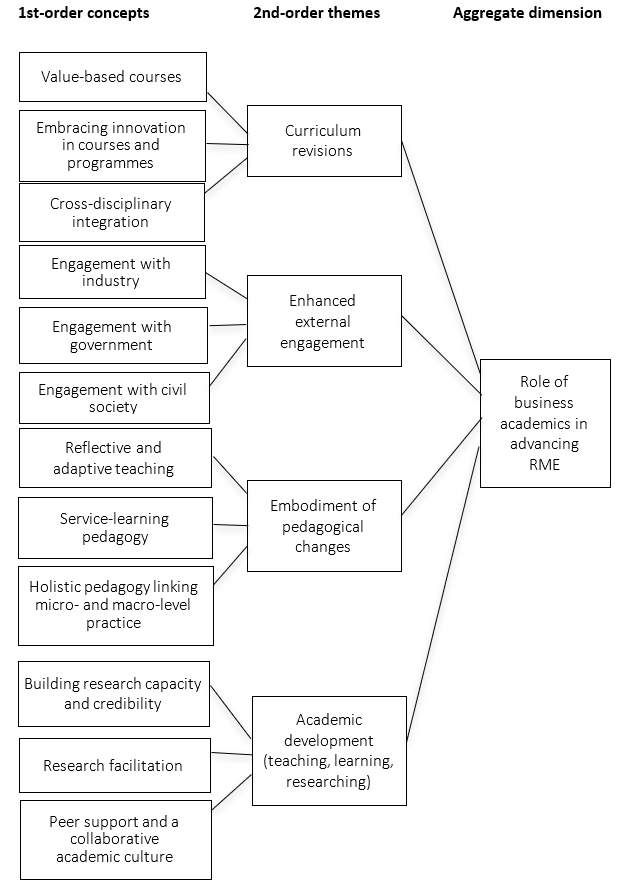
We analysed the retained articles using the Gioia methodology (Gioia et al., 2013), an inductive approach that allows themes to emerge from the literature rather than from a predetermined framework, which suits our aim of understanding what academics actually do. Although the method was developed for primary qualitative data, we applied it to published studies, treating each article’s reported findings as the data. We began with open coding, labelling recurring concepts about academics’ actions in language close to the original sources. We then grouped these first-order concepts into second-order themes that captured shared meaning across studies and distilled them into a single aggregate dimension: academics’ overall role in RME. Figure 2 shows the resulting data structure. Finally, we mapped each second-order theme against the UNPRME principles, linking our inductively derived findings to the wider RME discourse.
Figure Image
Figure 2: Gioia data structure for the role of business academics in RME
Analysis and Discussion
Business schools face widespread criticism for producing graduates with underdeveloped ethical mindsets and a narrow focus on shareholder primacy (Bishri, 2023; Russo et al., 2023). While institutional leadership often signs PRME commitments, the actual translation of these principles into educational practice depends on individual management educators. Using the PRME as an analytical lens, this review critically examines how management educators enact and operationalise responsible management principles in their everyday academic work. The synthesized findings provide a roadmap for educators navigating institutional constraints to embed a value-based, responsible approach across their teaching, research, and external engagement.
After a critical review of key literature, we identified four main themes: curriculum revisions, enhanced external engagement, pedagogical changes, and academic development, to guide a critical discussion of how business academics should redesign their systems toward a more sustainable, value-based approach. These themes are not mutually exclusive; rather, they interact and reinforce one another, reflecting the interconnected nature of the PRME principles.

Curriculum Revisions

The theme of curriculum revisions examines initiatives by business academics to redesign management curricula toward a more responsible, embedded approach. As noted earlier, business school graduates often lag in values compared with their knowledge (Bishri, 2023). Hence, management education should be redesigned to give students more opportunities to engage with the curriculum and strengthen their values. After all, UNPRME was introduced to make business graduates richer in values and responsibilities (UNPRME, 2007). Accordingly, this theme discusses initiatives by business academics to shift toward a more responsible management curriculum through value-based courses, course and programme innovation, and cross-disciplinary integration.

In value-based coursework, the literature documents a growing effort among management educators to design courses that emphasise global social responsibility and align module outcomes with international initiatives such as the SDGs and the UN Global Compact (Russo et al., 2023; UNPRME, 2023). Specifically, educators have restructured undergraduate and graduate offerings by introducing dedicated modules in business ethics and Corporate Social Responsibility (CSR) (Bishri, 2023; Christensen et al., 2007; Maloni et al., 2012; Rasche & Escudero, 2009; Young & Nagpal, 2013) and by championing specialised majors and joint tracks in sustainability (Maloni et al., 2012). To provide students with a well-rounded foundation, educators strive to balance management theory with ethics, legal liability, financial governance, and ecological stewardship (Bishri, 2023). Through these deliberate designs, educators directly enact the UNPRME principle of Values in the classroom.

Nevertheless, scholars emphasise that when educators deliver stand-alone modules, long-term impact remains constrained if courses are treated in isolation (Rasche & Gilbert, 2015). Although educators frequently introduce dedicated responsible management electives, this strategy often serves as a pragmatic compromise to circumvent institutional inertia and departmental resistance from colleagues in more conventional sub-disciplines (Rasche & Gilbert, 2015). Without broader curricular integration, educators find their efforts marginalized, leaving RME relegated to optional electives or co-curricular initiatives rather than embedded within compulsory degree requirements (Beddewela et al., 2017; Russo et al., 2023).
Academically developed scholars are more likely to embrace change, introduce innovative ideas, and design new courses and programmes that address contemporary challenges (Fujimoto et al., 2025). In this process, they are likely to collaborate with international bodies, creating opportunities for knowledge creation and dissemination. Such engagement enables business schools to cultivate leaders who are critical thinkers and visionaries, rather than merely practitioners. Moreover, other academic staff should support these initiatives (Beddewela et al., 2017; Doherty et al., 2015; Young & Nagpal, 2013). Importantly, shifting away from reliance on temporary academics toward a well-developed academic faculty strengthens business schools’ rigour and credibility (Dyllick, 2015). This, in turn, enhances their capacity to nurture and sustain responsible management education. This directly addresses the UNPRME’s purpose, values, research, and partnership in advancing responsible management education.

Cross-disciplinary integration involves collaboration across multiple academic disciplines to address sustainability challenges and provide holistic solutions. Since UNPRME focuses on equipping management education with values and sustainability, limiting it only to management education could be disadvantageous (Maloni et al., 2012). Therefore, as the research principle suggests, UNPRME should collaborate with other academic disciplines and institutions (Young & Nagpal, 2013). Because UNPRME highlights stakeholder engagement and global social responsibility, integrating management disciplines such as accounting, finance, and economics with law, political science, and the social sciences could help develop integrated, holistic solutions. As such, UNPRME’s research and partner principles could be further practiced.

In contrast, institutionalising such collaborative efforts has become increasingly challenging because most business schools view these collaborations as obstacles to the traditionally granted freedom of teaching and research (Rasche & Escudero, 2009). Moreover, while a few business academics recognise the importance of collaboration and embedded education, most focus on discipline-specific teaching (Russo et al., 2023). Research shows that not every management-related discipline gives responsible management equal prominence. For instance, academics with accounting and finance backgrounds gave responsible management the least prominence (Rasche & Gilbert, 2015).

Taken together, these findings suggest that curriculum revisions are necessary but insufficient on their own. Without complementary support for cross-disciplinary collaboration and sustained faculty buy-in, value-based courses risk remaining peripheral rather than becoming embedded practice.

Enhanced External Engagement

UNPRME’s principles include partnership, research, and dialogue. All three principles highlight the importance of collaborating with external parties to advance more responsible and sustainable management education (UNPRME, 2007). External engagement is crucial to adopting responsible education through UNPRME. Stakeholder engagement has three dimensions: business/industry, society, and government (Bishri, 2023). Accordingly, this study critically examines the initiatives business academics undertake to collaborate with these external parties, using the codes: engagement with industry, engagement with society, and engagement with government.

Engagement with industry: In the context of industry collaboration, the literature emphasises educators’ personal agency in bridging academic concepts and practitioner realities. Rather than relying solely on formal school-level agreements, individual academics establish collaborative research projects, author applied case studies, and supervise industry-linked student theses (Bishri, 2023; Borglund et al., 2019; Stachowicz-Stanusch, 2011). Furthermore, educators enrich classroom learning by inviting corporate practitioners as guest lecturers (Bishri, 2023) and connecting students with industry mentors (Borglund et al., 2019). By actively integrating these external voices into their courses, educators help students translate theoretical frameworks into practical, real-world applications (Dyllick, 2015). Therefore, business collaborations, such as partnership agreements and Memoranda of Understanding (MOUs), are being initiated to secure training opportunities for students. These partnerships typically share research outputs through joint publications and conference presentations. This creates a bridge between academics and industry, supporting ongoing dialogue on sustainability concerns (Dyllick, 2015). Hence, principles such as Research, Partner, and Share could be achieved through this.

Engagement with government and civil society: Beyond the corporate realm, individual business academics engage with policymakers and regulators to demonstrate how governance frameworks can enforce ethical practice, contributing scholarly insights to educational policy debates (Bishri, 2023). Similarly, educators partner with civil society organizations and NGOs, embedding community-based projects and advocacy campaigns directly into their course curricula (Bishri, 2023). Through these grassroots initiatives, academics operationalise the UNPRME principles of Partner, Research, and Share, ensuring that external collaboration translates into concrete student learning (Dyllick, 2015).

Although partnerships with external parties seem timely, relevant, and practical, scholars have argued that adopting UNPRME is ambiguous. Although UNPRME aims to promote sustainability, it offers principles to follow rather than a regulatory framework. As a result, many have collaborated with external parties to produce Sharing Information on Progress (SIP) reports. Consequently, the effectiveness, purpose, and outcomes of joint efforts with industry and civil society often remain unclear (Godemann et al., 2014, as cited in Rasche & Gilbert, 2015). In addition, scholars have debated the true intentions of business academics when they engage in research. Despite efforts to engage with industry to develop solutions to real-world problems organisations encounter, academics often focus on theoretical and conceptual problems within their disciplines. As a result, UNPRME interests and academic interests may conflict (Dyllick, 2015).

This demonstrates that external engagement, though valuable, cannot replace genuine curriculum integration. Business academics therefore need institutional incentives that reward engagement alongside traditional research metrics.

Embodiment of Pedagogical Changes

One of management education’s core responsibilities is to foster societal skills (Hawawini, 2005). To address global trends and challenges, management education must move beyond developing business managers who prioritise economic considerations alone (Ghoshal, 2005; Henisz, 2011). Business Management students must therefore be prepared to engage with complex, transdisciplinary issues and collaborate with the wider community at multiple levels (Abdelgaffar, 2021; Muff, 2013). Achieving this paradigm shift requires not only curriculum reform but also a critical pedagogical transformation (Dehler et al., 2001). This transformation is vital for embedding questioning behaviours and cultivating openness to change (Abdelgaffar, 2021). It also enables students to critically examine the role and conduct of business in contemporary global phenomena (Abdelgaffar, 2021; Thomas, 2005). Consequently, pedagogical practice must incorporate innovative approaches that integrate transdisciplinary learning (Abdelgaffar, 2021; Blasco, 2012; Maloni et al., 2012; Parkes et al., 2017; Starik et al., 2017), action-oriented and participatory research (Abdelgaffar, 2021), and active engagement with external communities (Abdelgaffar, 2021; Maloni et al., 2012; Starik et al., 2017).

As a result, business school academics must adopt more reflective and adaptive approaches to teaching and learning (Abdelgaffar, 2021; Painter-Morland et al., 2016), including real-world problem-based learning, issue-centered learning, and reflective fieldwork (Abdelgaffar, 2021; Painter-Morland et al., 2016). Moreover, ‘service-learning pedagogy’ (Collins & Kearins, 2010; Young & Nagpal, 2013), operationalised through internships and collaborations with community-based expertise, fosters a more integrated and interactive learning experience. Academics also need to incorporate holistic pedagogy to create a responsible educational climate. Furthermore, to support holistic pedagogy, academics must ensure that micro-level teaching practices connect to the macro level. In doing so, they must draw on a variety of sources rather than limiting themselves to textbooks (Maloni et al., 2012; Stambaugh & Trank, 2010).

Thus, carefully assessing pedagogical methods is essential to creating responsible education in business schools (Kearins & Springett, 2003; Maloni et al., 2012). However, hidden normative cultural barriers within the curriculum can hinder the implementation of critical pedagogy in conventional management education (Blasco, 2012; Louw, 2015; Millar & Price, 2018). Moreover, personal orientations and values play crucial roles in implementing this pedagogy (Maloni et al., 2012). In practice, achieving true cross-disciplinary integration is challenging because of limited resources, awareness, and time (Rusinko, 2010). As discussed, this approach aligns with UNPRME’s purpose, values, methods, research, partnerships, and dialogue.

Collectively, these pedagogical shifts require academics to move beyond content delivery and toward facilitating reflective, values-based learning. This repositioning requires sustained institutional support because individual academics alone cannot overcome deep-rooted cultural barriers.

Academic Development: Teaching, Learning and Researching (TLR)
Academic achievement is a critical turning point in advancing responsible management education within business schools. To do so, business school academics must continually build their research capacity and professional credibility, which underpin the real-world relevance that responsible management education requires (Brown & Duguid, 2001; Clinebell & Clinebell, 2008). While external engagement treats industry partnerships separately, this internal capacity enables academics to use them effectively once partnerships are formed (Fujimoto et al., 2025). This foundation is essential for embedding responsible management principles into conventional educational practices.

Regarding research facilitation, the literature underscores that educators advance the UNPRME Research principle by redirecting their scholarly agendas toward topics that generate sustainable social, economic, and environmental value (Dyllick, 2015; UNPRME, 2007). To sustain and legitimise this scholarship, academics actively build and leverage collaborative research clusters, ethics units, and cross-disciplinary working groups (Bishri, 2023; Maloni et al., 2012; Young & Nagpal, 2013). These internal platforms provide educators with vital peer support, collaborative opportunities, and access to funding and industry support (Bishri, 2023). Therefore, through ongoing research facilitation and peer collaboration, educators build the scholarly foundation needed to embed responsible principles into their teaching and institutional practice, while external engagement focuses on sharing these findings with broader societal stakeholders.

Overall, academic development serves as the connective thread across the other three themes. Curriculum revisions, external engagement, and pedagogical change each depend on academics who continually learn and adapt.

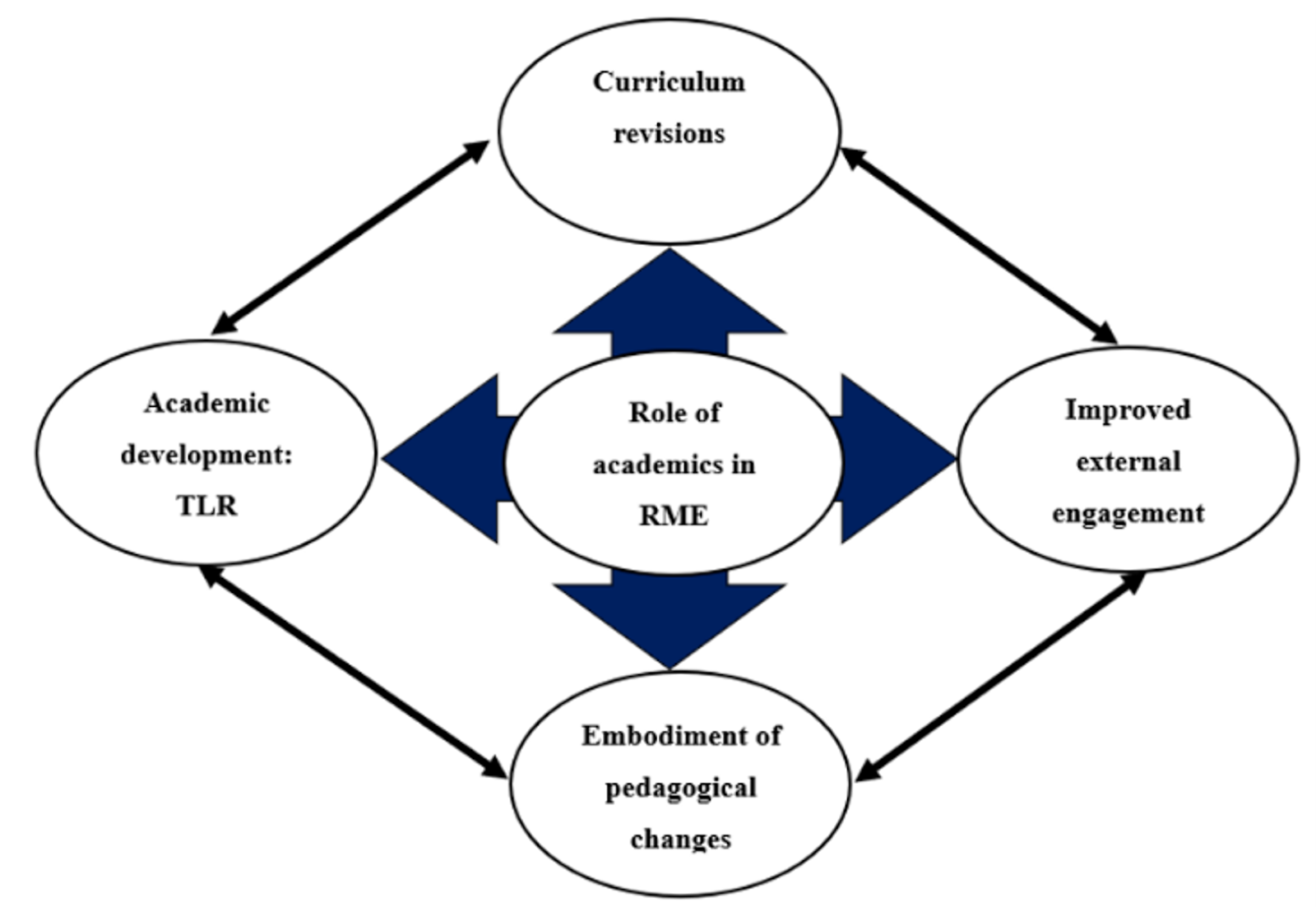
Drawing on the literature on academics’ roles in RME, this study develops a framework that reflects their integrated roles in RME (Figure 3), emphasising how their work connects and reinforces multiple dimensions of educational transformation. At the centre of the framework, academics’ role in RME links curriculum revisions, pedagogical changes, external engagement, and academic development. The bidirectional arrows among these four areas show that each dimension reinforces the others. Together, they form a dynamic and holistic framework that positions academics as key change agents in embedding and advancing RME within higher education institutions.
Figure Image
Figure 3: Role of academics in RME
This review contributes to the RME literature by shifting the unit of analysis from institutions to individual academics, addressing a gap, and conceptualising curriculum revisions, external engagement, pedagogical change, and academic development as interdependent rather than as separate initiatives. This integrated view extends prior work, which has largely treated these dimensions in isolation.

For business academics, the findings suggest that responsible management education is enacted through everyday choices in teaching, research, and collaboration. Academics can begin by embedding a single value-based module rather than waiting for a full curriculum overhaul. For business schools, the findings imply that supporting academic development through mentoring and protected time is essential. Without such support, individual academic efforts are unlikely to drive institution-wide change.
Conclusion
This study examined how business academics implement RME through the United Nations Principles for Responsible Management Education. Using the seven principles (Purpose, Values, Teach, Research, Partner, Practice, and Share) as a lens to review 42 studies, the study identified four themes in how academics contribute, including curriculum revisions, external engagement, pedagogical change, and academic development. Under curriculum revisions, academics introduce value-based courses, embrace innovation in courses and programmes, and build cross-disciplinary links. Under external engagement, they engage with industry, government, and civil society. Under pedagogical change, academics use experiential and reflective approaches that encourage critical thinking, openness, and values. Finally, under academic development, they build their research capacity, supported by research facilitation and peer support.
Earlier RME research has largely focused on institutions and programmes, leaving us with little understanding of what individual academics do. This review addresses that gap in three ways. It shifts the unit of analysis to the academic and proposes a framework in which the four themes reinforce one another, with academics as potential agents linking institutional goals to societal needs. It maps the evidence onto all seven principles, showing strong evidence for Research and Partner, suggesting that academics’ influence on RME depends on institutional support and challenging the assumption that signing UNPRME is enough.

Based on the study findings, the following recommendations are offered. First, business schools should recognise academic development through mentoring, protected time, and research support, as this appears to underpin the other three themes. Schools should also recognise responsible management work in promotion, workload, and research evaluation so that curriculum change and external engagement are not treated as extras. Further, academics should embed responsible management in core courses, not just electives, and can start with a single value-based module rather than waiting for a full curriculum overhaul. Moreover, schools and academics should build partnerships around shared outcomes, not only reporting, so that collaboration with industry, government, and civil society does not remain symbolic.

Study Limitations and Future Research

This study relied primarily on literature retrieved through Google Scholar. As a result, some relevant studies indexed elsewhere were missed. Because the thematic analysis is interpretive, the themes reflect our reading of the literature. We draw links between themes based on patterns across studies and have not tested them; these links indicate association rather than causation. Future research could repeat the review across several databases to verify and extend the framework. Empirical studies that survey or interview business academics directly would test how the framework works in practice, how individual and institutional factors interact, and whether it holds in different contexts, including developing economies. Future work could also examine the Practice principle, which the reviewed literature barely addresses.


Funding
The authors declared that no funding was received for the research, authorship, and publication of this article.
Conflicts of Interest
The authors declared no conflict of interest pertaining to the publication of this article.
AI Usage Disclosure
The authors declared no AI was used in the creation of this research article.
References

Abdelgaffar, H. A (2021). A review of responsible management education: Practices, outcomes and challenges. Journal of Management Development, 40(9/10), 613–638 . https://doi.org/10.1108/JMD-03-2020-0087

Ahmad, N.,, & Bibi, A (2023). Responsible management education: Mapping the trends, influential sources and research themes. Management & Sustainability: An Arab Review, 2(1) . 6–24. https://doi.org/10.1108/MSAR-08-2022-0038

Avelar, A. B. A., Farina, M. C.,, & da Silva Pereira, R (2022). Principles for Responsible Management Education – PRME: Collaboration among researchers. The International Journal of Management Education, 20(2) , Article 100642. https://doi.org/10.1016/j.ijme.2022.100642

Azmat, F., Jain, A.,, & Sridharan, B (2023). Responsible management education in business schools: Are we there yet? Journal of Business Research, 157, 113518. https://doi.org/10.1016/j.jbusres.2022.113518

Beddewela, E., Warin, C., Hesselden, F.,, & Coslet, A (2017). Embedding responsible management education – Staff, student and institutional perspectives. The International Journal of Management Education, 15(2), 263–279 . https://doi.org/10.1016/j.ijme.2017.03.013

Bishri, R (2023). Principles for responsible management education (PRME) in Sri Lankan business schools: A pathway to sustainable business education: A study of curricular integration, stakeholder engagement, and sustainable development outcomes. CINEC Academic Journal, 6(2), 94–103 . https://doi.org/10.4038/caj.v6i2.131

Blasco, M (2012). Aligning the hidden curriculum of management education with PRME: An inquiry-based framework. Journal of Management Education, 36(3), 364–388 . https://doi.org/10.1177/1052562911420213

Borglund, T., Prenkert, F., Frostenson, M., Helin, S.,, & Du Rietz, S (2019). External facilitators as ‘legitimizers’ in designing a master’s program in sustainable business at a Swedish business school – A typology of industry collaborator roles in RME. The International Journal of Management Education, 17(3), 100315 . https://doi.org/10.1016/j.ijme.2019.100315

Brown, J. S.,, & Duguid, P (2001). Knowledge and organization: A social-practice perspective. Organization Science, 12(2), 198–213 . https://doi.org/10.1287/orsc.12.2.198.10116

Burchell, J., Kennedy, S.,, & Murray, A (2015). Responsible management education in UK business schools: Critically examining the role of the United Nations principles for responsible management education as a driver for change. Management Learning, 46(4), 479–497 . https://doi.org/10.1177/1350507614549117

Christensen, L. J., Peirce, E., Hartman, L. P., Hoffman, W. M.,, & Carrier, J (2007). Ethics, CSR, and sustainability education in The Financial Times top 50 global business schools: Baseline data and future research directions. Journal of Business Ethics, 73(4), 347–368 . https://doi.org/10.1007/s10551-006-9211-5

Clinebell, S. K.,, & Clinebell, J. M (2008). The tension in business education between academic rigor and real-world relevance: The role of executive professors. Academy of Management Learning & Education, 7(1), 99–107 . https://doi.org/10.5465/amle.2008.31413867

Collins, E. M.,, & Kearins, K (2010). Delivering on sustainability’s global and local orientation. Academy of Management Learning & Education, 9(3), 499–506 . https://www.jstor.org/stable/25782033

Cullen, J. G (2020). Varieties of responsible management learning: A review, typology and research agenda. Journal of Business Ethics, 162(4), 759–773 . https://doi.org/10.1007/s10551-019-04362-x

Dehler, G. E., Welsh, M. A.,, & Lewis, M. W (2001). Critical pedagogy in the ‘new paradigm’. Management Learning, 32(4), 493–511 . https://doi.org/10.1177/1350507601324005

Doherty, B., Meehan, J.,, & Richards, A (2015). The business case and barriers for responsible management education in business schools. Journal of Management Development, 34(1), 34–60 . https://doi.org/10.1108/JMD-06-2013-0082

Dyllick, T (2015). Responsible management education for a sustainable world: The challenges for business schools. Journal of Management Development, 34(1), 16–33 . https://doi.org/10.1108/JMD-02-2013-0022

Fujimoto, Y., Azmat, F., Presbitero, A., Homer, S. T., Poon, W. C.,, & Lim, W. M (2025). Navigating paradoxes of responsible management education (RME): Insights from the Global South. Studies in Higher Education, 51(8), 1864–1881 . https://doi.org/10.1080/03075079.2025.2546955

Ghoshal, S (2005). Bad management theories are destroying good management practices. Academy of Management Learning & Education, 4(1), 75–91 . https://doi.org/10.5465/amle.2005.16132558

Gioia, D. A., Corley, K. G.,, & Hamilton, A. L (2013). Seeking qualitative rigor in inductive research: Notes on the Gioia methodology. Organizational Research Methods, 16(1), 15–31 . https://doi.org/10.1177/1094428112452151

Godemann, J., Haertle, J., Herzig, C.,, & Moon, J (2014). United Nations supported principles for responsible management education: Purpose, progress and prospects. Journal of Cleaner Production, 62, 16–23 . https://doi.org/10.1016/j.jclepro.2013.07.033

Hawawini, G (2005). The future of business schools. Journal of Management Development, 24(9), 770–782 . https://doi.org/10.1108/02621710510621286

Henisz, W. J (2011). Leveraging the financial crisis to fulfil the promise of progressive management. Academy of Management Learning & Education, 10(2), 298–321 . https://doi.org/10.5465/amle.10.2.zqr298

Henrique, J., Filho, W. L., Salvia, A. L., Lourenção, M., Guimarães, Y. M., Trevisan, L. V., Barbir, J.,, & Cristina, A (2024). Responsible management education: The leadership role of PRME business schools. The International Journal of Management Education, 22(1), 100920 . https://doi.org/10.1016/j.ijme.2023.100920

Henrique, J., Laura, M., Goi, H. C., Lourenção, M., Pires, E., Leticia, L., Salvia, A. L., Silva, D. R., Silveira, M., Baars, C.,, & Cristina, A (2025). Towards student-centric learning approaches for responsible management education: The relevance of PRME business schools. The International Journal of Management Education, 23(3), 101194 . https://doi.org/10.1016/j.ijme.2025.101194

Kearins, K.,, & Springett, D (2003). Educating for sustainability: Developing critical skills. Journal of Management Education, 27(2), 188–204 . https://doi.org/10.1177/1052562903251411

Louw, J (2015). “Paradigm change” or no real change at all? A critical reading of the U. N. principles for responsible management education. Journal of Management Education, 39(2), 184–208 . https://doi.org/10.1177/1052562914547965

Maloni, M. J., Smith, S. D.,, & Napshin, S (2012). A methodology for building faculty support for the United Nations principles for responsible management education. Journal of Management Education, 36(3), 312–336 . https://doi.org/10.1177/1052562911430310

Millar, J.,, & Price, M (2018). Imagining management education: A critique of the contribution of the United Nations PRME to critical reflexivity and rethinking management education. Management Learning, 49(3), 346–362 . https://doi.org/10.1177/1350507618759828

Moratis, L (2013). A tale of two standards on responsible management education. Journal of Global Responsibility, 4(2), 138–156 . https://doi.org/10.1108/jgr-05-2013-0008

Muff, K (2013). Developing globally responsible leaders in business schools: A vision and transformational practice for the journey ahead. Journal of Management Development, 32(5), 487–507 . https://doi.org/10.1108/02621711311328273

Nonet, G., Kassel, K.,, & Meijs, L (2016). Understanding responsible management: Emerging themes and variations from European business school programs. Journal of Business Ethics, 139(4), 717–736 . https://doi.org/10.1007/s10551-016-3149-z

Page, M. J., McKenzie, J. E., Bossuyt, P. M., Boutron, I., Hoffmann, T. C., Mulrow, C. D., Shamseer, L., Tetzlaff, J. M., Akl, E. A., Brennan, S. E., Chou, R., Glanville, J., Grimshaw, J. M., Hróbjartsson, A., Lalu, M. M., Li, T., Loder, E. W., Mayo-Wilson, E., McDonald, S., … Moher, D (2021). The PRISMA 2020 statement: An updated guideline for reporting systematic reviews. BMJ, 372 , n71. https://doi.org/10.1136/bmj.n71

Painter-Morland, M., Sabet, E., Molthan-Hill, P., Goworek, H.,, & de Leeuw, S (2016). Beyond the curriculum: Integrating sustainability into business schools. Journal of Business Ethics, 139(4), 737–754 . https://doi.org/10.1007/s10551-015-2896-6

Parkes, C., Buono, A. F.,, & Howaidy, G (2017). The principles for responsible management education (PRME): The first decade – What has been achieved? The next decade – responsible management education’s challenge for the Sustainable Development Goals (SDGs). The International Journal of Management Education, 15(2), 61–65 . https://doi.org/10.1016/j.ijme.2017.05.003

Peschl, H., Sug, I., Ripka, E.,, & Canizales, S (2023). Combining best practices framework with benchmarking to advance principles for responsible management education (PRME) performance. The International Journal of Management Education, 21(2), 100791 . https://doi.org/10.1016/j.ijme.2023.100791

Rasche, A.,, & Escudero, M (2009). Leading change – The role of the principles for responsible management education. Zeitschrift für Wirtschafts- und Unternehmensethik, 10(2), 244–250 . https://doi.org/10.5771/1439-880x-2009-2-244

Rasche, A.,, & Gilbert, D. U (2015). Decoupling responsible management education: Why business schools may not walk their talk. Journal of Management Inquiry, 24(3), 239–252 . https://doi.org/10.1177/1056492614567315

Rusinko, C. A (2010). Integrating sustainability in management and business education: A matrix approach. Academy of Management Learning & Education, 9(3), 507–519 . https://www.jstor.org/stable/25782034

Russo, F., Wheeldon, A. L., Shrestha, A.,, & Saratchandra, M (2023). Responsible management education in business schools – High on principles but low on action: A systematic literature review. The International Journal of Management Education, 21(3), 100843 . https://doi.org/10.1016/j.ijme.2023.100843

Sahni, J., Darda, P.,, & Gaur, S. S (2025). Integration of principles for responsible management education principles (PRME) in Saudi Arabian universities: A thematic analysis of claims on university websites. Society and Business Review, 20(3) . https://doi.org/10.1108/SBR-11-2024-0374

Smith, S. M., Cripps, K., Stokes, P.,, & Séraphin, H (2023). The principles for (ir)responsible management education: An exploration of the dynamics of paradox, the hidden curriculum, competencies and symbolization. Management Learning, 54(3), 384–395 . https://doi.org/10.1177/13505076231164018

Solitander, N., Fougère, M., Sobczak, A.,, & Herlin, H (2012). We are the champions: Organizational learning and change for responsible management education. Journal of Management Education, 36(3), 337–363 . https://doi.org/10.1177/1052562911431554

Stachowicz-Stanusch, A (2011). The implementation of principles for responsible management education in practice – research results. Journal of Intercultural Management, 3(2), 241–257 . https://joim.pl/wp-content/uploads/2020/02/JOIM-3–2.pdf

Stambaugh, J. E.,, & Trank, C. Q (2010). Not so simple: Integrating new research into textbooks. Academy of Management Learning & Education, 9(4), 663–681 . https://www.jstor.org/stable/25782053

Starik, M., Rands, G., Marcus, A. A.,, & Clark, T. S (2017). From the guest editors: In search of sustainability in management education. Academy of Management Learning & Education, 9(3), 377–383 . https://doi.org/10.5465/amle.9.3.zqr377

Storey, M., Killian, S.,, & O’Regan, P (2017). Responsible management education: Mapping the field in the context of the SDGs. The International Journal of Management Education, 15(2), 93–103 . https://doi.org/10.1016/j.ijme.2017.02.009

Thomas, T. E (2005). Are business students buying it? A theoretical framework for measuring attitudes toward the legitimacy of environmental sustainability. Business Strategy and the Environment, 14(3), 186–197 . https://doi.org/10.1002/bse.446

UNPRME (2007). The principles for responsible management education. United Nations Global Compact. https://www.unprme.org/

UNPRME (2023). What we do. https://www.unprme.org/what-we-do/

Young, S.,, & Nagpal, S (2013). Meeting the growing demand for sustainability-focused management education: A case study of a PRME academic institution. Higher Education Research & Development, 32(3), 493–506 . https://doi.org/10.1080/07294360.2012.695339

Jump to Reference ↓